


Preschool early literacy- steps to mastering letter writing skills

Hi all! I would like to apologise for not updating my blog regularly 🤣 Please pardon me. Life has been very exciting for me, having to juggle a toddler and a semi-full time job as a therapist!
In the last few months, many parents have come forward to request for preschool literacy intervention. I'm privileged to be able to actively serve in the preschool sector for 6 years and more, thereby staying updated and improving my craft.
Many preschool children lack the foundational literacy skills and writing skills. This may stem from the lack of practise opportunities and exposure, as well as inefficient ways of being taught phonics and/ writing skills. To acquire basic writing skills, one must first have a strong foundation in his or her fine motor skills. And this training starts from birth- progressing from crawling on all fours, to pull-to-stand, followed by pencil-holding knowledge, to producing different strokes, and so on. Very often, parents play an important role in providing such experiences from young.
So how do we start exposing our children to writing? As young as 1 year old, besides working on self-feeding, parents can expose their children to various hands-on activities (e.g. Superdot activities, scooping sand from sandpit to pail, spreading chocolate onto bread, etc.)
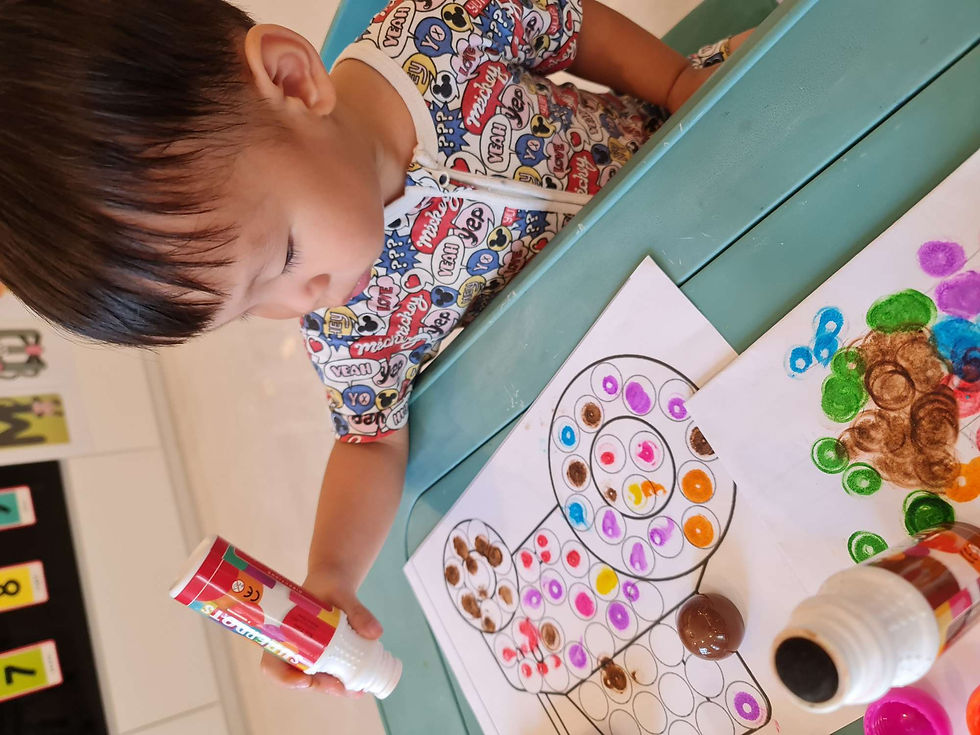
Superdot activity that my son enjoys!
When the child has gained better fine control, parents can start introducing their child to tracing activities. Here, we are not looking at how neat a child can trace. But rather, we are focusing on how well a child can control the marker.

Example of a simple tracing activity
Once the child has gained even more refined fine motor, it's time to work on their pencil holding skills. It is natural for all children to start holding pencil using palmer-grasp method. Slowly, we need to guide them the correct way of holding pencil. One can use a pencil grip to practice.

Colouring activities from simply doodling to neater colouring within the outlines
Once tracing skills have been established, parents can slowly wean off from tracing the broken lines to tracing without the broken lines. If the parent is teaching the child how to write a letter, do teach each letter explicitly and provide visuals to associate the letter as well as to recite the strokes (eg. For letter 'p', you go down the puppy's body and circle the head). This will allow for easy retrieval of each letter name and strokes.
Example of tracing without the broken line. Image taken from Letterland book.
Lastly, once the child can trace the strokes of the letter without prompt, parents can get the child to produce the letter from memory (do recite the strokes when your child is writing the letter- this serves as a reinforcement). Slowly but surely, the child will be able to produce all the strokes independently!
A video of my son writing a-z (almost) independently at 2.5 years old.
Do practice writing with your child regularly! Small efforts like this will go a long way!
Looking for someone to guide your young ones in their writing? Feel free to chat with me to find out more!
Love,
Ms Cherie


Students order college essays for sale because they need some help with their enormous workload. It is quite natural, that students want to achieve amazing results without applying too much effort and turn their paper on time. Here you can pay for essays and get affordable, professional and highly-qualified essay service.